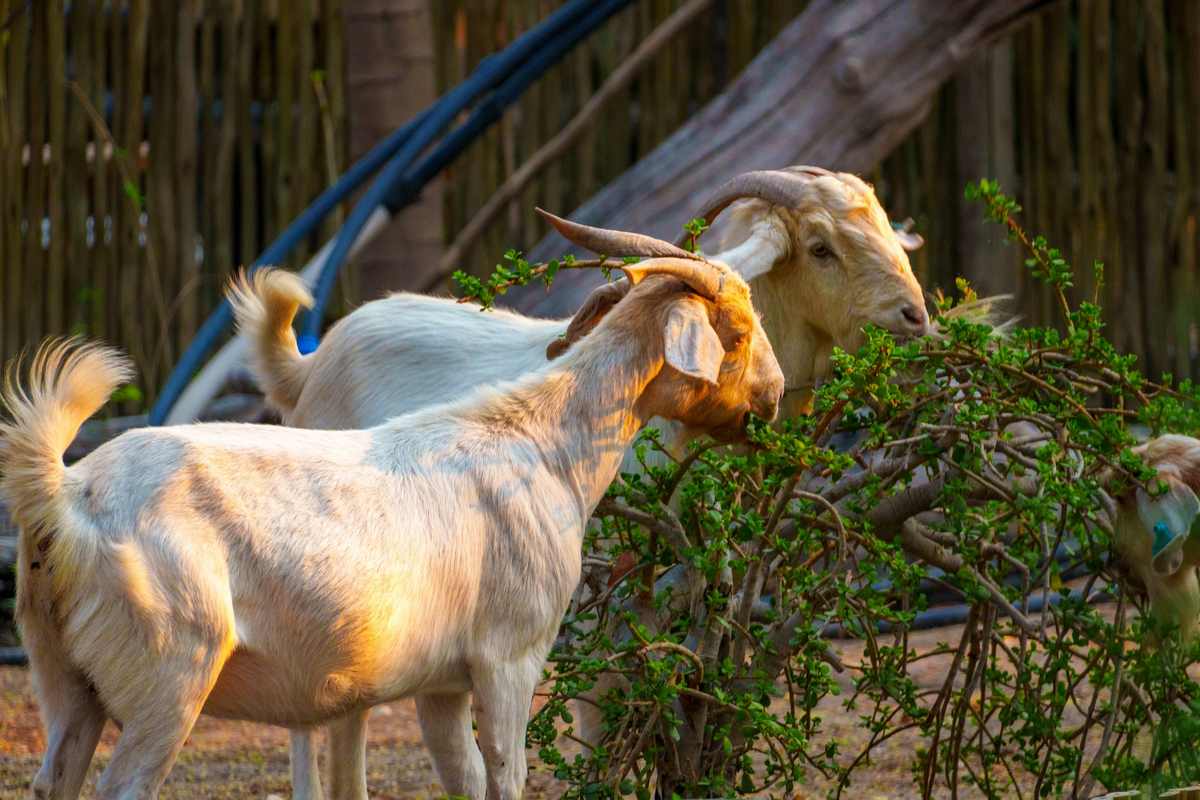
Goats are browsers, not grazers, and that single fact explains most of what makes feeding them different. They prefer shrubs, weeds, brambles, twigs, bark and leafy branches at head height over short grass at their feet, and their diet should be built around that preference rather than against it.
The other thing to know early is copper. Goats need considerably more of it than sheep, and feeding sheep minerals to goats causes a deficiency that is easy to avoid and unpleasant to fix.
Browsers, Not Grazers
Cattle and sheep are grazers, built to eat grass close to the ground. Goats evolved on scrubby, mountainous terrain where survival meant reaching up for leaves, bark, twigs and woody plants that other livestock could not use. Given a choice, a goat will strip a bramble thicket before touching a good pasture.
This has two practical consequences. Goats are outstanding at clearing overgrown ground, which is why they are hired for exactly that job. And goats kept on grass-only pasture are being fed against their nature, which tends to show up as poor condition and a much higher parasite burden, because grazing at ground level is where they pick up worms.
Quick Facts: Why Browsing Matters
- Goats prefer vegetation at head height over ground-level grass
- Browse means shrubs, brambles, weeds, twigs, bark and tree leaves
- Browsing keeps them away from ground level, which lowers parasite load
- Goats will clear overgrown scrub other livestock ignore
- A goat on grass-only pasture is working against its own biology
The Daily Diet
- Browse and pasture. The foundation where available, ideally including woody and weedy growth, not just grass.
- Hay. The winter staple and the fallback whenever browse runs short. Grass hay suits most goats; alfalfa suits milkers and growing kids needing more protein and calcium.
- Grain or pellets. Fed to milkers, pregnant does and growing kids that need more than forage supplies. Most maintenance goats do not need grain at all.
- Loose minerals. Goat-specific, offered free-choice, not a block.
- Clean water. Constantly. Goats are notably fussy and will drink less if water is dirty.
Grain is where a lot of goats get into trouble. Sudden or excessive grain causes bloat and can trigger enterotoxaemia. Any change in ration should be introduced gradually across a week or more. For specific products and feeding by life stage, our goat feed guide goes into detail.
Copper: The Difference That Matters
Goats require substantially more dietary copper than sheep, and sheep are unusually sensitive to copper toxicity. Because of that, sheep minerals are deliberately copper-restricted.
Feed those sheep minerals to goats over any length of time and you produce copper deficiency: a faded, rusty-looking coat, a fish-tail appearance to the tail hair, poor growth, and reduced fertility. The fix is straightforward, use loose minerals formulated specifically for goats. Never assume a generic “sheep and goat” mineral is adequate, because those are usually formulated to the sheep’s lower tolerance.
Loose minerals are preferable to blocks. A goat’s tongue is not well suited to getting a useful amount off a hard block, and intake is difficult to judge.
Plants That Are Toxic to Goats
The “goats eat anything” reputation is dangerous here. Goats are actually fairly selective, but they will sample unfamiliar plants, and several ornamentals common in yards are seriously toxic.
| Plant | Note |
|---|---|
| Rhododendron and azalea | Among the most common serious goat poisonings |
| Mountain laurel | Same plant family, equally dangerous |
| Yew | Extremely toxic, small amounts can be fatal |
| Wilted wild or black cherry leaves | Wilting is the danger, it releases cyanide compounds |
| Milkweed | Toxic and commonly present in pasture |
| Oleander | Highly toxic |
| Nightshades | Includes green potato foliage and related plants |
Worth stressing: wilted cherry leaves are more dangerous than fresh ones. A branch that falls or is pruned into a goat pen becomes hazardous as it dries, so clear prunings rather than leaving them.
The Bottom Line
Give goats browse rather than just grass, good hay when browse is short, goat-specific loose minerals with adequate copper, and grain only where production genuinely demands it. Then walk your fence line and remove the rhododendron.
If you are choosing animals, see our guide to goat breeds for beginners. For how goats compare with the rest of the yard, see what most farm animals eat, or browse the full farm feed hub.
Other feeding guides in this group (ruminants): cows eat, sheep eat. Or start from the overview of what most farm animals eat.
Browsers. Goats prefer shrubs, weeds, brambles, twigs, bark and leaves at head height over ground-level grass. That is why they clear overgrown scrub so effectively and why grass-only pasture suits them poorly.
No, that is a myth. Goats are curious and will taste-test unfamiliar things, but they are fairly selective feeders. The reputation is dangerous because several common ornamental plants, including rhododendron, azalea and yew, are seriously toxic to them.
No, not long term. Sheep minerals are deliberately copper-restricted because sheep are sensitive to copper toxicity, while goats need considerably more. Feeding them to goats causes copper deficiency, showing as a faded rusty coat, fish-tail hair, poor growth and reduced fertility.
Most maintenance goats do not. Grain is for milkers, pregnant does and growing kids whose needs exceed what forage supplies. Introduce any grain gradually, because sudden increases cause bloat and can trigger enterotoxaemia.
Rhododendron, azalea, mountain laurel, yew, oleander, milkweed, nightshades, and wilted wild or black cherry leaves. Wilted cherry leaves are more dangerous than fresh ones, so clear prunings out of goat pens.
Both have a place. Browse and pasture are ideal in season, ideally including woody and weedy growth rather than just grass. Hay is the winter staple and the fallback whenever browse runs short.