Categories
Farm Animals

Raising Rabbits for Meat: A Practical Beginner’s Guide

Rabbits are the most space-efficient meat livestock available to a smallholder. A trio of one buck and two does can produce a steady supply of meat from a footprint smaller than a garden shed, on feed you can partly grow yourself, with no need for a tractor, pasture or slaughterhouse booking.

They are also the livestock people are most likely to underestimate, both in the work involved and in how quickly the numbers compound.

Why Rabbits Work on Small Acreage

  • Space. A breeding trio needs a few hutches, not a paddock.
  • Speed. Kits reach processing weight at around 8 to 12 weeks depending on breed.
  • Feed conversion. Rabbits convert feed to meat efficiently, and can use forage and garden surplus.
  • Quiet. Effectively silent, which matters where neighbours or ordinances do.
  • Manure. Rabbit manure is a cold manure, it can go straight onto beds without composting first.

That last point is genuinely useful if you garden. Unlike chicken manure, which will burn plants unless composted, rabbit droppings can be applied directly. Our guide to making your own fertilizer covers where it fits.

Meat Breeds Worth Considering

BreedMature weightNotes
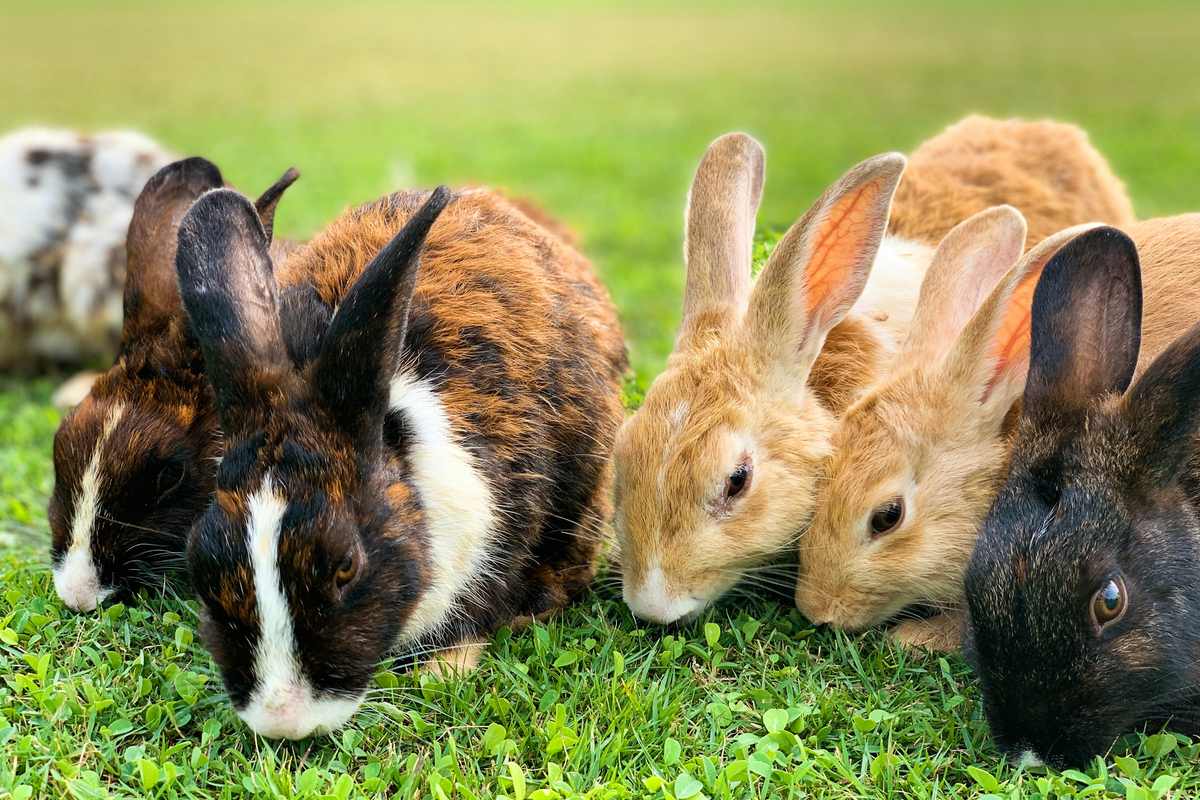
New Zealand White~9–12 lbThe commercial standard. Fast growing, good carcass, widely available.
Californian~8–10 lbSimilar performance, slightly smaller. Often crossed with New Zealands.
Silver Fox~9–12 lbHeritage American breed, calm temperament, good mothers.
Rex~7–10 lbDual purpose, the pelt has real value alongside the meat.
Flemish Giant~15 lb+Large but slower growing and less feed-efficient. Often crossed rather than kept pure.

New Zealand Whites and Californians dominate for a reason: they hit weight quickly and predictably. Heritage breeds are worth considering if temperament and self-sufficiency matter more to you than pure conversion rates.

Housing

Rabbits need shelter from weather, from predators, and above all from heat. Cold is survivable for a healthy adult rabbit; heat is not. Rabbits struggle above roughly 85°F and heat stress kills quickly, so shade and airflow matter more than insulation in most US climates.

Wire-floored hutches with a resting board keep animals out of their own waste and simplify collecting manure, though they need to be well made to avoid sore hocks. Colony housing on the ground is possible and more natural, but complicates disease and breeding management. Whichever you choose, build for predators, dogs, raccoons and mink all take rabbits.

Quick Facts: Rabbit Meat Production

  • Gestation is roughly 31 days
  • Litters typically 6–10 kits
  • Processing weight reached at about 8–12 weeks
  • A doe can raise several litters per year
  • Heat above ~85°F is the biggest single risk to adult rabbits

Feeding

Commercial rabbit pellets are the reliable base, supplemented with good grass hay, which rabbits need constantly for gut health and dental wear. Beyond that, rabbits use a lot of what a garden produces: leafy greens, carrot tops, brassica leaves, dandelion, plantain and comfrey.

Introduce fresh greens gradually, particularly to young rabbits, because sudden changes cause digestive upset. Avoid anything wet, mouldy, or from the nightshade family, and never feed lawn clippings, which ferment fast. Growing your own forage is very achievable at this scale, see growing your own livestock feed.

The Realistic Downsides

Two things put people off, and both are worth knowing before you start rather than after. The first is that you will be processing the animals yourself. There is essentially no commercial slaughter infrastructure for rabbits at smallholder scale, so this is a skill you have to acquire and be comfortable with.

The second is that rabbits breed exactly as fast as the cliché suggests, and the maths compounds quickly. Without a plan for every animal produced, a trio becomes an unmanageable population within a season. Decide your processing schedule before you breed, not after.

There is also a legal dimension in some places: check local ordinances on keeping and processing rabbits, and on selling meat, which is usually far more restricted than producing it for your own household.

The Bottom Line

For anyone with limited space who wants to produce a real share of their own meat, rabbits are arguably the most practical option available, provided you are prepared to do the processing. Start with a trio, plan for heat, and know your numbers before the first litter arrives.

For a wider look at what suits a starting smallholding, see easy animals to raise for beginners, or browse the full farm animals hub.

For the feeding side in full, see our guide to what rabbits eat.

Is raising rabbits for meat worth it?

For small acreage, often yes. Rabbits need very little space, convert feed efficiently, reach processing weight in 8 to 12 weeks and are silent. The main barrier is that you must process them yourself, as there is little commercial infrastructure at smallholder scale.

What is the best rabbit breed for meat?

New Zealand White and Californian are the commercial standards, reaching good weight quickly and predictably. Silver Fox is a calm heritage alternative, and Rex adds pelt value alongside the meat.

How long does it take to raise a meat rabbit?

Roughly 8 to 12 weeks to processing weight, depending on breed and feeding. Gestation is about 31 days and litters are commonly 6 to 10 kits, so production compounds fast.

How many rabbits do you need to start?

A trio of one buck and two does is the standard starting point. That is enough to produce a steady supply without immediately creating more animals than you can manage.

What do meat rabbits eat?

Commercial pellets as the base, plus constant access to grass hay for gut health and dental wear. They also use garden surplus well, leafy greens, carrot tops, dandelion and comfrey. Introduce fresh greens gradually and never feed lawn clippings.

What temperature is dangerous for rabbits?

Heat is the bigger risk than cold. Rabbits begin to struggle above about 85°F and heat stress can kill quickly, so shade, ventilation and airflow matter more than insulation in most climates.

Categories
Farm Animals

Livestock Guardian Dogs: Breeds, Bonding and What They Actually Do

A livestock guardian dog is not a herding dog. It does not move stock, it lives with them and drives predators off. These are large, independent breeds selectively bred over centuries to have almost none of the prey drive that makes a normal dog dangerous around sheep, goats or poultry.

Understanding that distinction is the difference between a working guardian and an expensive, frustrated pet that chases your livestock.

Guardian vs Herding: Not the Same Job

Herding breeds like Border Collies work with a handler, using a modified prey drive to gather and move animals. They are intense, biddable and constantly taking direction.

Guardian breeds work alone, often at night, and make their own decisions. Independence is a feature, not a training failure. They bond to the stock rather than to a handler, patrol territory, and escalate from watching to barking to physical confrontation as a threat gets closer. A guardian that ignores your recall while standing between a coyote and your goats is doing exactly what it was bred to do.

The Main Breeds Compared

BreedTemperamentNotes
Great PyreneesCalm, attentive, very trustworthy with stockThe most popular LGD in the US. Barks a lot at night, which is the job. Heavy coat.
Maremma SheepdogClosely bonded, less prone to wanderingItalian breed, similar to the Pyrenees but somewhat smaller. Strongly stock-focused.
Anatolian ShepherdHighly territorial, fast to respondMore reactive and escalates quicker. Needs experienced handling and solid fencing.
AkbashIndependent, agile, watchfulTurkish breed, leaner and faster than the Pyrenees.
KomondorProtective, distinctive corded coatEffective but the coat is a genuine maintenance commitment.

For most smallholders in the US, the Great Pyrenees or the Maremma are the sensible starting point: both are noted for being attentive to stock and reliable around them. Anatolians and Komondors are highly capable but less forgiving of inexperienced handling.

Bonding a Guardian to Stock

There is an old piece of advice that guardian pups must be raised with no human contact so they bond only to livestock. It is outdated and it is wrong. These breeds have historically lived alongside pastoralist families, and modern practice recognises that human socialisation is an important part of raising a working dog, you still need to catch it, treat it, and move it.

What matters is that the dog grows up with stock, in their space, from a young age, and that its correct behaviours are supported and its incorrect ones interrupted. Puppies play, and a playful pup can injure lambs or poultry without meaning to, so early supervision is essential rather than optional.

Quick Facts: Raising a Working LGD

  • Raise the pup with the stock it will guard, in their space
  • Human socialisation is necessary, the no-contact advice is outdated
  • Supervise early, playful pups can injure young stock accidentally
  • Expect real maturity at around two years, not six months
  • Two dogs often work better than one on larger or more exposed ground

What They Need From You

  • Serious fencing. These dogs expand their territory if allowed. Roaming is the single most common complaint, and it is usually a fencing problem.
  • Tolerant neighbours. Guardians bark at night on purpose. It is the primary deterrent and it carries.
  • Space. They are not suited to small suburban lots regardless of temperament.
  • Patience. An LGD is not reliable at six months. Most mature into the job around two years old.
  • Routine care. Large breeds, heavy coats, and outdoor lives mean parasite control and coat management matter.

Are They Worth It?

If you are losing stock to coyotes, foxes, raccoons or dogs, a well-raised guardian is one of the few genuinely effective non-lethal answers, and it works around the clock without you. If your losses are occasional and your ground is small and well fenced, the cost, noise and commitment may not be justified.

They pair particularly well with goats and sheep, and with poultry given careful early training. If you are building a flock, see our guides to easy animals to raise for beginners and poultry farming for beginners, or browse the full farm animals hub.

What is a livestock guardian dog?

A large breed raised to live permanently with livestock and deter predators. Unlike herding dogs, guardians do not move stock, they bond to it, patrol territory and confront threats independently, usually without a handler present.

What is the best livestock guardian dog breed for beginners?

The Great Pyrenees or the Maremma Sheepdog. Both are noted for being attentive to stock and trustworthy around it. Anatolian Shepherds and Komondors are highly capable but more reactive and better suited to experienced handlers.

Do livestock guardian dogs need training?

They need raising rather than obedience training. The guarding behaviour is largely genetic. What you provide is early exposure to the stock they will guard, supervision while they are young enough to play roughly, and correction of unwanted behaviour.

Should you avoid human contact with an LGD puppy?

No, that advice is outdated. These breeds have always lived alongside people, and you need to be able to handle, treat and move the dog. Socialise it with humans while raising it with the stock.

Why do livestock guardian dogs bark so much at night?

Barking is the primary deterrent, and most predator activity is nocturnal. A guardian that barks through the night is working. It is also the most common source of neighbour complaints, so consider your setting before getting one.

At what age is a livestock guardian dog reliable?

Usually around two years. They mature slowly, and a six-month-old pup is still likely to play with stock. Expect a long runway before the dog is fully trustworthy unsupervised.

Categories
Farm Animals

Pygmy Goats: Size, Temperament and What They Need

Pygmy goats are small, stocky, hardy goats kept mostly as companions and, historically, for meat. They stand around 16 to 21 inches at the withers but are noticeably heavier-built than other miniature goats, with short legs and a barrel body.

They are frequently confused with Nigerian Dwarfs, which are a similar height but a completely different type of animal. If you want milk, you almost certainly want the other breed.

Pygmy Goats at a Glance

Pygmy Goat
TypeMeat and companion breed
OriginWest Africa, imported to the US in the 1950s
Height~16–21 inches at the withers
Weight~50–85 lb, heavy for their height
BuildStocky, short-legged, barrel-bodied
MilkPossible but short, roughly 120–180 days
TemperamentFriendly, curious, very people-oriented
Best forCompanionship, brush clearing, small-scale meat

Why Pygmies Get Confused With Nigerian Dwarfs

Both are miniature goats of roughly the same height, and both are sold as backyard goats, so the two names get used almost interchangeably. The breeds are genuinely different in purpose.

A Pygmy is built like a compact meat goat: wide, deep-bodied and short-legged, which makes it look substantially larger than a Nigerian Dwarf of identical height. A Nigerian Dwarf is built like a scaled-down dairy goat, lean and leggy. The practical difference is milk. If dairy is the goal, see our guide to Nigerian Dwarf goats instead.

Temperament and Why People Keep Them

Pygmies have a deserved reputation as the friendliest of the miniature goats. They are curious, social, tolerant of handling and genuinely entertaining, which is why they turn up so often as pets, in petting zoos, and as companions for horses.

That sociability comes with the standard goat caveat: they need other goats. A Pygmy kept alone with a horse or a dog for company is still a lonely goat, and lonely goats are loud, destructive and prone to escaping.

Quick Facts: Keeping Pygmy Goats

  • Always keep at least two, they are herd animals
  • Hardy and adaptable, they handle varied climates well
  • Excellent brush clearers for their size
  • Prone to obesity, they gain weight easily on rich feed
  • Very good with handling, which makes hoof trimming and worming easier

Feeding and Care

Pygmies are browsers like all goats, and do best with access to shrubs, weeds and brambles rather than grass alone, our guide to what goats eat covers this in full. The one breed-specific warning is weight: Pygmies gain condition very easily and an overweight Pygmy is a common and avoidable welfare problem. Most do not need grain at all unless pregnant, lactating or growing.

They need goat-specific loose minerals with adequate copper, never sheep minerals, which are copper-restricted. Hoof trimming every six to eight weeks and a worming plan are the other routine jobs. Common health problems across small goats are covered in our guide to common diseases of farm animals.

Fencing and Housing

Small goats are escape artists, and Pygmies combine determination with a body shape that fits through gaps. Woven wire with openings small enough that a kid cannot put its head through is the practical standard; anything with wide horizontal gaps will be defeated.

Shelter needs to be dry and draught-free rather than warm. Goats tolerate cold far better than damp, and a three-sided shelter facing away from prevailing weather is usually enough in most US climates.

Are Pygmy Goats a Good Choice?

If you want friendly, low-maintenance small livestock that clears brush and is good with people, they are an excellent choice. If you want milk, buy Nigerian Dwarfs instead. And whichever you choose, buy two.

For a wider comparison, see our goat breeds for beginners guide, or browse the full farm animals hub.

Are Pygmy goats good pets?

Yes, they are among the friendliest and most people-tolerant of the miniature goat breeds, which is why they are common as companion animals. They still need at least one other goat for company, though, a goat alone is a stressed goat.

What is the difference between Pygmy and Nigerian Dwarf goats?

Pygmies are meat and companion goats, stocky and short-legged with a short lactation. Nigerian Dwarfs are dairy goats, lean and longer-legged, milking for around 10 months. They are similar in height but bred for different purposes.

Do Pygmy goats produce milk?

They can, but only for a short lactation of roughly 120 to 180 days, and in modest quantity. If milk is your goal, a Nigerian Dwarf or a full-size dairy breed is the better choice.

How big do Pygmy goats get?

Around 16 to 21 inches at the withers and roughly 50 to 85 lb. Their stocky build makes them look larger than other miniature goats of the same height.

How long do Pygmy goats live?

Commonly 10 to 15 years with good care, so they are a genuine long-term commitment rather than a short-term project.

Do Pygmy goats need grain?

Usually not. They gain weight very easily and obesity is a common problem in pet Pygmies. Grain is generally only needed for pregnant, lactating or growing animals.

Categories
Farm Animals

Nigerian Dwarf Goats: A Complete Guide to the Miniature Dairy Breed

The Nigerian Dwarf is a miniature dairy goat: about the size of a large dog, but built and bred to milk. They stand roughly 17 to 21 inches at the withers and produce milk with a butterfat content around 6 to 10%, considerably richer than any full-size dairy breed.

That combination, small enough for a backyard and productive enough to be worth milking, is why they have become the default first dairy goat for smallholders in the US.

Nigerian Dwarf at a Glance

Nigerian Dwarf
TypeMiniature dairy goat
Height~17–21 inches at the withers
Weight~60–80 lb
BuildLean and refined, longer-legged, a scaled-down dairy goat
MilkRoughly 1–2 quarts a day at peak
Butterfat~6–10%, higher than standard dairy breeds
LactationLong, often around 10 months
Best forSmall-acreage milk, cheese and soap making

Nigerian Dwarf vs Pygmy Goat

This is the single most common point of confusion, and it matters because buying the wrong one for your purpose is an expensive mistake. The two breeds are close in height, so people assume they are interchangeable. They are not.

Nigerian Dwarfs are dairy goats. Pygmy goats are meat and companion goats. A Pygmy will lactate, but for a much shorter period, typically around 120 to 180 days against the Nigerian Dwarf’s roughly 10 months. If milk is the goal, the breed choice is already made.

Build tells them apart on sight once you know what to look for. Nigerian Dwarfs are lean and refined with longer legs, essentially a full-size dairy goat scaled down. Pygmies are stocky, heavy-set and short-legged, which makes them look bigger despite similar height. Our guide to pygmy goats covers that side in full.

Quick Facts: Telling Them Apart

  • Nigerian Dwarf = dairy breed, Pygmy = meat and companion breed
  • Similar height, very different build: Dwarf lean, Pygmy stocky
  • Nigerian Dwarf lactates ~10 months, Pygmy roughly 120–180 days
  • Nigerian Dwarf milk is exceptionally high in butterfat
  • Buy for purpose, not for size, they are not interchangeable

Milk Production and What It Is Good For

A good Nigerian Dwarf doe gives somewhere around one to two quarts a day at peak lactation. That is modest next to a Nubian or Saanen, but it comes from an animal eating far less and needing far less space, and the milk itself is unusually rich.

That butterfat percentage is the real selling point. It makes the milk noticeably sweet and creamy to drink, and it makes it excellent for cheese, where yield tracks butterfat, and for soap making. If you have ever been told goat milk tastes strong, that is usually a management or breed issue rather than an inherent one, and Nigerian Dwarf milk tends to surprise people.

Keeping Nigerian Dwarfs

They need what all goats need, with the caveat that small goats are harder to fence, not easier. Anything a Nigerian Dwarf kid can get its head through, it will eventually get its whole body through.

  • Space. Far less than full-size goats, but they still need room to move and browse.
  • Fencing. Woven wire with small openings. Small goats exploit gaps larger breeds cannot.
  • Company. Never keep one alone. Goats are herd animals and a solitary goat is a stressed goat.
  • Browse. They are browsers like any goat, see what goats eat for the detail.
  • Minerals. Goat-specific loose minerals with adequate copper, never sheep minerals.
  • Shelter. Draught-free and dry. Small goats lose heat faster than large ones.

For feeding a doe in milk specifically, our goat feed guide covers rations by life stage.

Registries and Buying

Nigerian Dwarfs can be registered with the American Goat Society, the American Dairy Goat Association, and the International Dairy Goat Registry, among others. Registration matters if you intend to sell breeding stock or show, and matters much less if you simply want milk for the house.

What matters more when buying is the doe’s udder attachment, her dam’s milking record if available, and general health. Buy from someone who milks their own animals and will let you see them milked.

Are Nigerian Dwarfs a Good First Goat?

For most smallholders wanting milk, yes. They are manageable in size, genuinely productive, and easier to handle than a full-size dairy breed for anyone who has not kept goats before. The main caveats are that you need at least two, and that small goats test fencing harder than people expect.

If you are still deciding between breeds, see our guide to goat breeds for beginners, or browse the full farm animals hub.

What is the difference between a Nigerian Dwarf and a Pygmy goat?

Purpose and build. Nigerian Dwarfs are dairy goats, lean and longer-legged, lactating around 10 months. Pygmy goats are meat and companion goats, stocky and short-legged, with a much shorter lactation of roughly 120 to 180 days. They are similar in height but are not interchangeable.

How much milk does a Nigerian Dwarf goat produce?

Roughly one to two quarts a day at peak lactation. That is less than a full-size dairy breed, but from a much smaller animal, and the milk is far richer, with butterfat around 6 to 10%.

How big do Nigerian Dwarf goats get?

About 17 to 21 inches at the withers and roughly 60 to 80 lb, so a large-dog sized animal.

Is Nigerian Dwarf goat milk good for cheese?

Yes, unusually so. Cheese yield tracks butterfat, and Nigerian Dwarf milk is among the highest-butterfat goat milk available, which also makes it popular for soap making.

Can you keep just one Nigerian Dwarf goat?

No. Goats are herd animals and a single goat becomes stressed and vocal. Keep at least two, and plan fencing carefully, small goats escape through gaps that hold larger breeds.

Are Nigerian Dwarf goats good for beginners?

Generally yes, for anyone wanting milk on small acreage. They are easier to handle than full-size dairy breeds and genuinely productive. The main challenges are needing a companion and requiring tighter fencing than people expect.

Categories
Farm Animals

Duck Breeds for Beginners: Meat, Egg-Laying & Ornamental Guide

If you’re adding ducks to your farm animals lineup, breed choice matters more than most beginners expect. A duck bred for fast meat production behaves and looks completely different from one bred to lay 300 eggs a year, and a purely ornamental breed won’t produce much of either.

Our guide to raising ducks for eggs and meat covers the day-to-day basics of housing, water, and feeding. This guide goes deeper on the breeds themselves — nine of the most common meat, egg-laying, and dual-purpose or ornamental duck breeds, plus what to weigh before picking one.

Categories
Farm Animals

Chicken Coop Plans: How to Build a Coop Step by Step

A good chicken coop is the single most important investment you’ll make when you start keeping chickens. It’s what stands between your flock and a raccoon at 2am, what keeps them dry through a February storm, and what determines whether collecting eggs is a five-minute joy or a daily headache. This guide walks through everything that goes into building a proper chicken coop, from sizing and materials to predator-proofing, ventilation, and nesting boxes — plus a few solid ready-made options if building from scratch isn’t for you.

If you haven’t already worked out flock size, feeding, and the basics of getting started, our guide on how to get started with raising chickens covers that ground first. This article picks up where that one leaves off and goes deep on the coop itself.

Categories
Farm Animals

Goat Breeds for Beginners: Meat, Dairy & Small Breeds Guide

If you’re building out your farm animals lineup, goats are one of the most rewarding additions you can make. They’re hardy, personable, and come in dozens of breeds suited to almost any homestead, whether you’re after meat, milk, or just a couple of easygoing companions to clear brush.

The tricky part isn’t whether to raise goats — it’s figuring out which of the many goat breeds actually fits your space, your climate, and your goals. A dairy breed bred for high milk yields is a poor match for someone who just wants a couple of low-maintenance browsers, and a large meat breed needs very different fencing than a Pygmy goat.

This guide breaks down the most popular meat goat breeds, dairy goat breeds, and small goat breeds, plus what you should think through before bringing your first goats home.

Categories
Farm Animals

Raising Ducks for Eggs and Meat: A Beginner’s Guide

Chickens tend to get all the attention when people think about backyard poultry, but raising ducks deserves a serious look too. Ducks are hardier in bad weather, better foragers, and several breeds are noticeably quieter than a rooster crowing at dawn.

If you’ve already gone through getting started with raising chickens, a lot of the basics will feel familiar — but ducks have their own quirks, especially around water, that are worth understanding before you bring any home.

Categories
Farm Animals

Poultry Farming for Beginners

Poultry Farming is the process in which a variety of different domestic birds are raised for their eggs, feathers, and meat.

First things first, you’ll need to decide what type of poultry farm you want to start. We’ve got a comprehensive breakdown of the different types of birds you can choose from to get you started.

Choosing the right location is also crucial to the success of your poultry farm. We’ll provide tips on how to find a suitable and accessible location for your feathered friends.

Of course, you’ll need to equip your farm with the essentials to keep your birds healthy and happy. We’ve compiled a list of must-have equipment for your small-scale poultry farm.

And before you jump headfirst into this new venture, we’ll discuss the pros and cons of poultry farming, so you can make an informed decision.

So, whether you’re a complete novice or have some experience under your belt, this guide will provide you with everything you need to start your poultry farming journey.

Categories
Farm Animals

What Are the Common Diseases of Farm Animals?

Farm or agricultural animals are reliable when it comes to putting food on the table for farmers and consumers alike.

However, livestock producers can only reap these benefits when the animals are alert, aware, and virus-free. In short, farm animals should be healthy animals.

To achieve this state, a farmer must ensure proper animal maintenance and care. It’s also important to know common diseases animals can get on farms, as these allow farmers to understand disease control and curing their animals.

This article is equipped with everything you need to know about animals on farms and the diseases that commonly affect them.

We’ll also look at disease prevention, cures, and outbreak control.