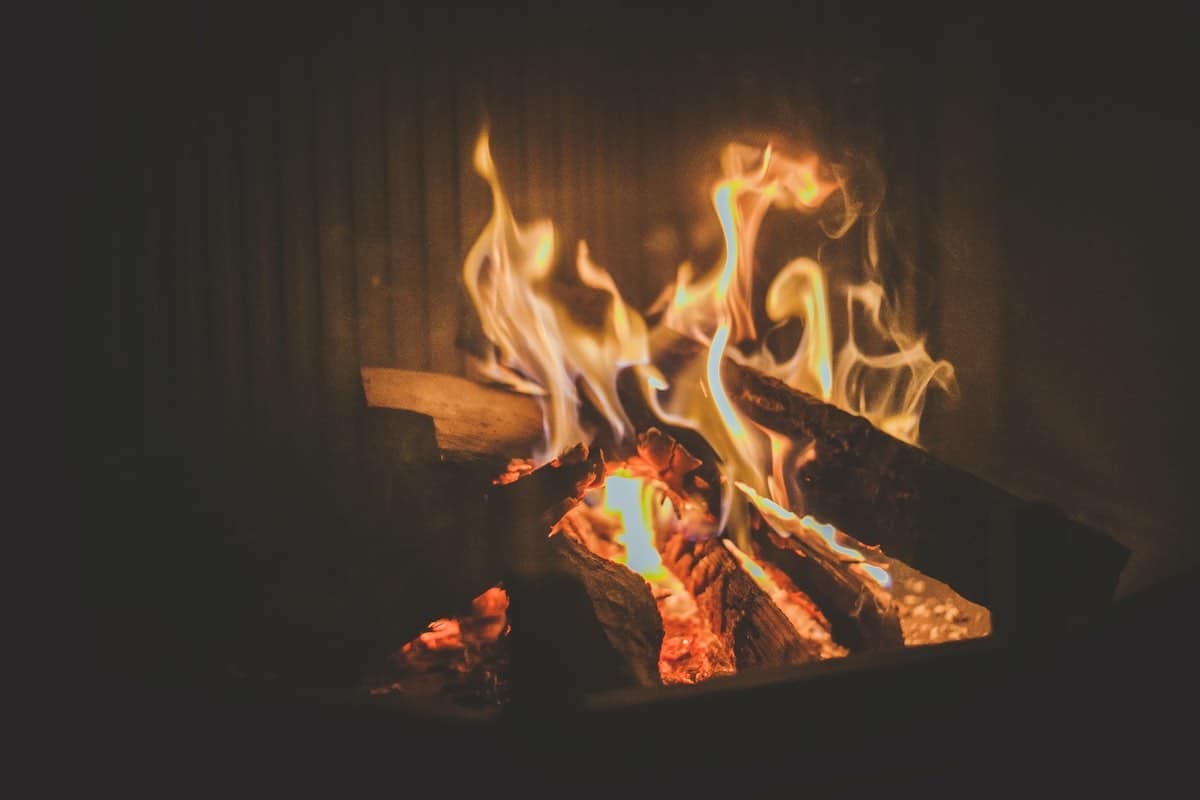
Planting trees for firewood is one of the most patient, far-sighted things a homesteader can do. You’re making a decision today that will heat your home five, ten, or twenty years from now — and if you choose the right species and manage them well, you’re creating a renewable fuel supply that replenishes itself indefinitely. Think of it as planting a future woodpile. If you have land as part of your homesteading setup, dedicating even a small section to firewood trees is one of the smartest long-term investments you can make.
The concept is called a firewood rotation: you plant trees in phases so that as one group reaches harvestable size, another is already growing behind it. A well-managed woodlot can supply your full heating needs indefinitely, with nothing more than chainsaw fuel and physical labor as ongoing inputs.
In this guide we cover the best trees to grow for firewood on a US homestead — from slow-burning oak to fast-payoff black locust — along with a BTU comparison table, planting tips, and a breakdown of how much firewood a typical home actually needs.
What Makes a Good Firewood Tree?
Not all wood is equal when it comes to heating your home. Before you decide what to plant, it helps to understand the criteria that separate great firewood trees from mediocre ones.
Hardwood vs. softwood. Hardwoods (deciduous trees that lose their leaves) are almost universally better for firewood than softwoods (conifers like pine, fir, and spruce). Hardwoods are denser, burn longer, produce more heat, and leave behind good coals rather than burning to ash quickly. Softwoods also contain more resin, which can build up as creosote in your chimney and become a fire hazard.
BTU output. BTU (British Thermal Unit) is the measure of heat energy a cord of wood produces when burned. Denser hardwoods produce more BTUs per cord. Numbers typically range from around 13–14 million BTU per cord for low-density species like willow, up to 27–30 million BTU for hickory — meaning hickory can produce more than twice as much heat from the same volume of wood.
Drying time (seasoning). Freshly cut wood has 40–60% moisture content. Burning wet wood is inefficient and produces far more smoke and creosote. Most hardwoods need 1–2 years of proper seasoning in a dry, ventilated stack before they burn well. Some species (ash, black locust) dry faster than others (oak).
Splitting ease. Dense wood that splits easily saves significant time and energy at the chopping block. Species like ash and black locust split cleanly along the grain; knotty or interlocked-grain species like elm can be a nightmare to split by hand and may require a hydraulic splitter.
Growth rate. This determines your return timeline. Some hardwoods like black locust can reach harvestable size in 5–7 years; oak may take 20–40 years to produce logs worth cutting. For a working homestead, the right answer is usually a mix of fast and slow growers planted simultaneously so you have both near-term and long-term supply.
Best Hardwood Trees for Firewood
These are the species that serious homesteaders and woodlot managers consistently rely on. They offer the best combination of heat output, availability, and manageability on a small to medium property.
Oak
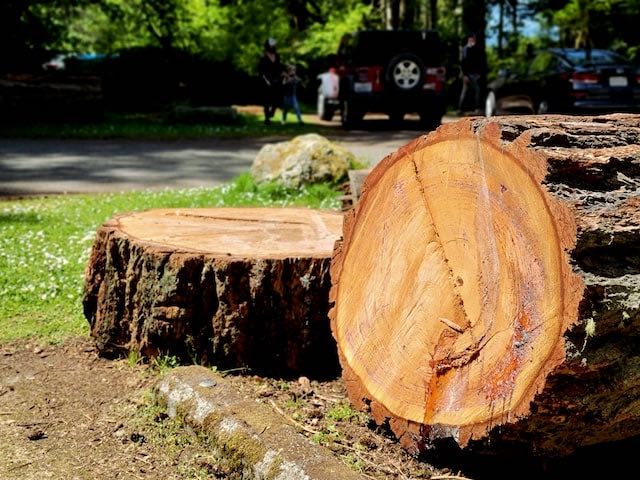
Oak is the benchmark against which all other firewood trees are measured. It’s dense, burns long and hot, and produces excellent sustained heat with minimal smoke. A cord of oak delivers 24–28 million BTUs depending on the species — comparable to a cord of coal in heat output.
The main trade-off is patience. Oak needs to be cut and stacked for a full two years before it’s properly seasoned. Rush it and you’ll spend your winter fighting damp wood that barely burns and coats your flue with creosote.
White oak vs. Red oak: White oak is slightly denser and produces more heat (around 26–29 million BTU/cord) compared to red oak (24–26 million BTU/cord). White oak also has a more closed grain structure that makes it slightly harder for moisture to penetrate, which can actually speed up seasoning in some conditions. Both are excellent choices. Red oak is more widely distributed across the eastern US, while white oak tends to produce a more impressive tree. For a long-term woodlot, planting both is a solid strategy.
Hickory
Hickory is the king of firewood in terms of raw heat output. At 27–30 million BTUs per cord, it burns hotter and longer than any other common North American firewood species. If you’re heating a large home through a cold winter, hickory is your best friend.
It’s also one of the best woods for smoking meat — a bonus for homesteaders who cure their own pork or beef. The rich, nutty smoke flavor hickory produces is unmatched.
The downsides: hickory is notoriously difficult to split, especially from large logs with interlocked grain. You’ll want a good maul and possibly a hydraulic splitter. It also grows relatively slowly compared to black locust or ash, and requires 1.5–2 years of seasoning. But for pure heating efficiency, no other species competes.
Black Locust
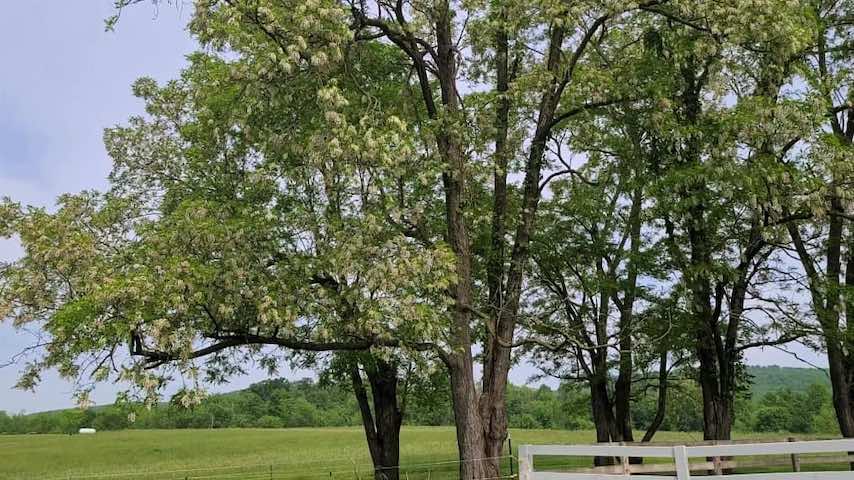
Black locust is the homesteader’s secret weapon in the firewood world. It grows extremely fast — you can have harvestable-sized logs in just 5–7 years — yet it burns nearly as hot as hickory, putting out around 26–27 million BTUs per cord. It’s also naturally rot-resistant to the point that fence posts made from black locust can last 50+ years in the ground without treatment.
Black locust seasons surprisingly quickly for such a dense wood — 6–12 months is enough in many cases. It splits reasonably well along the grain, though mature logs with lots of twist can be challenging.
The caveats: black locust spreads aggressively through root sprouts and can become invasive if you’re not managing it. In some eastern states it’s considered invasive. Plant it in a defined woodlot area where you can control its expansion, not near garden beds or fence lines. The tree also has sharp thorns on younger growth, so gloves and long sleeves are a must when harvesting. It’s also toxic to horses and livestock if eaten, so keep it fenced off from grazing areas. For small-scale farming operations wanting fast firewood returns, black locust is hard to beat.
Ash
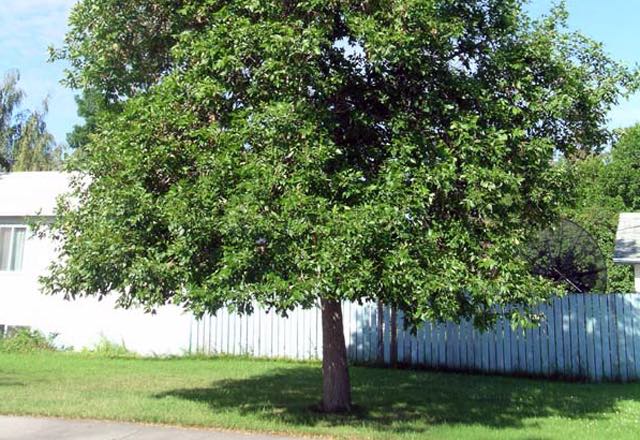
Ash has long been one of the most beloved firewood species in North America for good reason: it produces good heat (about 20–24 million BTU/cord), splits easily and cleanly, and dries significantly faster than oak. Some seasoned homesteaders will burn ash in as little as 6–9 months after cutting when stacked in a dry, ventilated location.
The unfortunate reality is that ash trees across much of the eastern and midwestern US are under threat from the emerald ash borer (EAB), an invasive beetle that has killed hundreds of millions of ash trees since arriving in North America in the early 2000s. If you’re in an affected area, planting ash as a primary firewood species carries significant risk. That said, in areas not yet affected by EAB, ash remains an excellent choice — and trees cut for firewood before EAB infestation takes hold aren’t wasted, since the wood burns just as well.
Maple
Hard maple (sugar maple) is a top-tier firewood species with around 24–25 million BTUs per cord — comparable to white oak. It burns cleanly, produces long-lasting coals, and splits reasonably well from straight-grained logs. Sugar maple also offers a significant bonus if you’re in the right climate zone (USDA zones 3–8): sap for maple syrup. A mature sugar maple grove can produce syrup AND firewood from the same trees over their lifetime, making them one of the most versatile investments in a homestead planting plan.
Red maple and silver maple are softer and lower in BTU output (around 18–20 million BTU/cord) but grow faster than hard maple and are still decent secondary firewood options. If syrup production isn’t a priority, consider silver maple as a faster-growing supplementary species alongside black locust.
Fast-Growing Firewood Options
If you need heat-producing wood on a shorter timeline, these species sacrifice some BTU output in exchange for faster growth. They’re best used as a bridge to tide you over while slower hardwoods mature, or as supplemental species in a mixed woodlot.
Hybrid Poplar
Hybrid poplar is one of the fastest-growing trees in North America, capable of adding 5–8 feet per year in good conditions. In 4–6 years you can have logs ready to cut. The trade-off is heat output — poplar produces only around 13–14 million BTUs per cord, roughly half of what hickory delivers. It burns quickly and doesn’t hold coals well, making it better suited to shoulder-season use (spring and fall) than deep winter heating. It’s a useful species to plant as a quick-return component of a mixed woodlot while oaks and hickories mature.
Alder
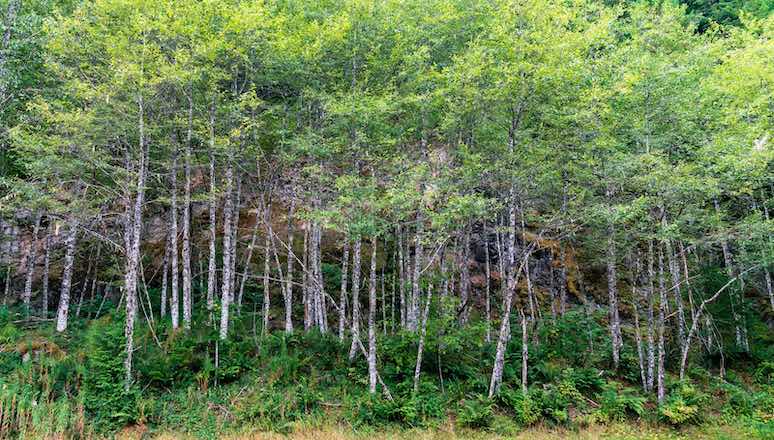
Red alder is a fast-growing species native to the Pacific Northwest that produces reasonable heat (around 17–19 million BTU/cord) and seasons quickly. It’s one of the few fast-growing species that fixes nitrogen in the soil through root nodules — meaning it actually improves the land it grows on, making it a particularly good choice for a diversified homestead planting. If you’re in the Pacific Northwest, alder is a practical and locally available firewood tree that outperforms most other fast-growing options in that climate.
Willow
Willow is one of the fastest-growing trees on earth — certain varieties will produce coppiceable wood in just 3–4 years. It makes decent kindling and is useful for quick biomass production. However, with around 13 million BTU/cord and high moisture content that requires thorough seasoning, willow is a supplementary species rather than a primary firewood tree. Its best use in a homestead woodlot is as kindling production or as a coppiced willow stand for rapid biomass, while the serious firewood comes from denser hardwoods planted alongside it.
BTU Comparison Table
Use this table to compare the key firewood characteristics of the main species at a glance. BTU figures are per cord (a standard stack 4 ft × 4 ft × 8 ft).
| Tree Species | BTU per Cord (millions) | Drying Time | Splitting Ease | Growth Rate |
|---|---|---|---|---|
| Hickory | 27–30 | 1.5–2 years | Moderate–Hard | Slow–Moderate |
| Black Locust | 26–27 | 6–12 months | Moderate | Fast (5–7 yrs) |
| White Oak | 26–29 | 2 years | Easy–Moderate | Slow (20+ yrs) |
| Red Oak | 24–26 | 2 years | Easy–Moderate | Moderate |
| Hard Maple | 24–25 | 1–1.5 years | Moderate | Slow–Moderate |
| Ash | 20–24 | 6–12 months | Easy | Moderate–Fast |
| Alder | 17–19 | 6–9 months | Easy | Fast |
| Silver Maple | 18–20 | 1 year | Easy | Moderate–Fast |
| Hybrid Poplar | 13–14 | 8–12 months | Easy | Very Fast (4–6 yrs) |
| Willow | ~13 | 3–4 months | Very Easy | Very Fast (3–4 yrs) |
How to Plant Firewood Trees
Growing a firewood woodlot doesn’t require forestry expertise, but a few planning decisions make a big difference in how productive and sustainable your stand becomes.
Spacing
For a dedicated firewood woodlot, plant trees at 8–10 foot spacing. This is tighter than you’d use for a timber or ornamental planting, but firewood trees benefit from competition — it drives them to grow taller and straighter, producing better log-quality wood. You can always thin the stand over time, burning the thinned material as you go. If you’re planting into existing pasture or along fence lines, 12–15 foot spacing is more practical.
Coppicing for Sustainable Harvest
Coppicing is one of the oldest and most effective techniques for producing firewood sustainably from the same trees, year after year. You cut the tree down to a low stump (called a “stool”), and the stump sends up multiple new shoots the following spring. These shoots grow faster than a tree from seed because they have an established root system, and after 5–8 years you cut again. The cycle repeats almost indefinitely — some coppice stools in the UK are over 1,000 years old.
Black locust, alder, willow, and hazel are all excellent coppice species. Oak and maple can be coppiced but don’t respond as vigorously. For a homestead firewood system, dedicating even a quarter-acre to a managed coppice stand of black locust can produce a meaningful supply of wood on a rotation without ever replanting.
When to Plant
Plant bare-root trees in late winter or very early spring, while they’re still dormant. Container-grown trees can go in any time the ground isn’t frozen, but early fall and early spring are best — they give the roots time to establish before the stress of summer heat. Water new plantings thoroughly for the first season, especially in dry spells. Most firewood trees are drought-tolerant once established but need support through their first 1–2 years. A drip irrigation system or regular hand watering during the establishment phase dramatically improves survival rates. For a broader look at irrigation options, our complete guide to farm irrigation systems has everything you need to plan a setup for a small woodlot or farm.
How Much Firewood Do You Need?
Before you start planning your woodlot, it helps to know what your actual demand is. A cord of wood is a standardized measure: a neatly stacked pile 4 feet high, 4 feet wide, and 8 feet long, equaling 128 cubic feet of stacked wood.
The average US home using wood as a primary heat source burns 2–3 cords of hardwood per winter. A well-insulated home in a moderate climate (think Virginia or Kansas) might need 1.5–2 cords; a drafty older home in Minnesota or Vermont in a cold winter could need 4–5 cords. As a rough planning target, budget 3 cords per year.
How many trees do you need for 3 cords per year? It depends on species, tree size, and rotation length, but a general rule of thumb: one acre of managed hardwood woodlot can sustainably produce around 1–2 cords of firewood per year on a harvested rotation. So for self-sufficiency in firewood, you’re looking at 2–3 acres of dedicated woodlot with a staggered planting plan. This is very achievable on a typical homestead property — and those trees do double duty providing wildlife habitat, windbreaks, and carbon sequestration in the meantime. You can read more about making the most of your land in our farm supplies hub.
Frequently Asked Questions
Black locust is the best choice for most homesteaders wanting a balance of fast growth and high heat output — it reaches harvestable size in 5–7 years and burns nearly as hot as hickory. For maximum heat output without time pressure, hickory is unbeatable. For an all-round long-term investment with bonus uses (syrup, wildlife habitat), oak or sugar maple are excellent choices.
It depends on the species. Fast growers like willow and hybrid poplar can be cut in 4–6 years. Black locust reaches usable size in 5–7 years. Ash takes around 10–15 years. Oak and hickory take 20–40 years to produce large logs, though you can take smaller rounds from thinning much earlier. The smart approach is to plant a mix — fast growers for near-term supply, slow growers for long-term premium firewood.
A cord is the standard unit for measuring firewood in the US. It’s a neatly stacked pile of split wood measuring 4 feet high × 4 feet wide × 8 feet long, totaling 128 cubic feet of stacked wood. The actual solid wood content is around 80–90 cubic feet depending on how tightly the pieces are stacked. A face cord (or rick) is a third of a full cord — one row of 16-inch splits stacked 4 feet high and 8 feet long.
Softwood isn’t useless, but it’s not ideal for primary heating. Pine, fir, and cedar burn hot and fast, which makes them excellent for kindling and starting fires. The problems: they burn through quickly (less heat per cord than hardwood), they contain resin that can build up as creosote in the flue, and they don’t hold coals well. Use softwood as a fire-starter alongside hardwood, but rely on hardwood for the sustained heat that warms a home through the night.
Hickory burns the longest of any common North American firewood species. It’s the densest widely available hardwood, and a well-stoked fire of seasoned hickory will hold coals through the night better than almost anything else. White oak, hard maple, and black locust are close runners-up for sustained burning.
Start Planting Your Future Woodpile
The best time to plant a firewood tree was twenty years ago. The second best time is this spring. Even a small planting of black locust, oak, and hybrid poplar today — mixed to cover both fast and slow return timelines — sets your homestead up with a renewable heating supply that can last a lifetime. Combine that with a good coppice rotation and you may never need to buy firewood again. For everything else you need to stock and run a productive homestead, explore the rest of our guides across growing, building, and land management.

One reply on “The Best Trees to Grow for Firewood”
[…] The Best Trees to Grow for Firewood […]