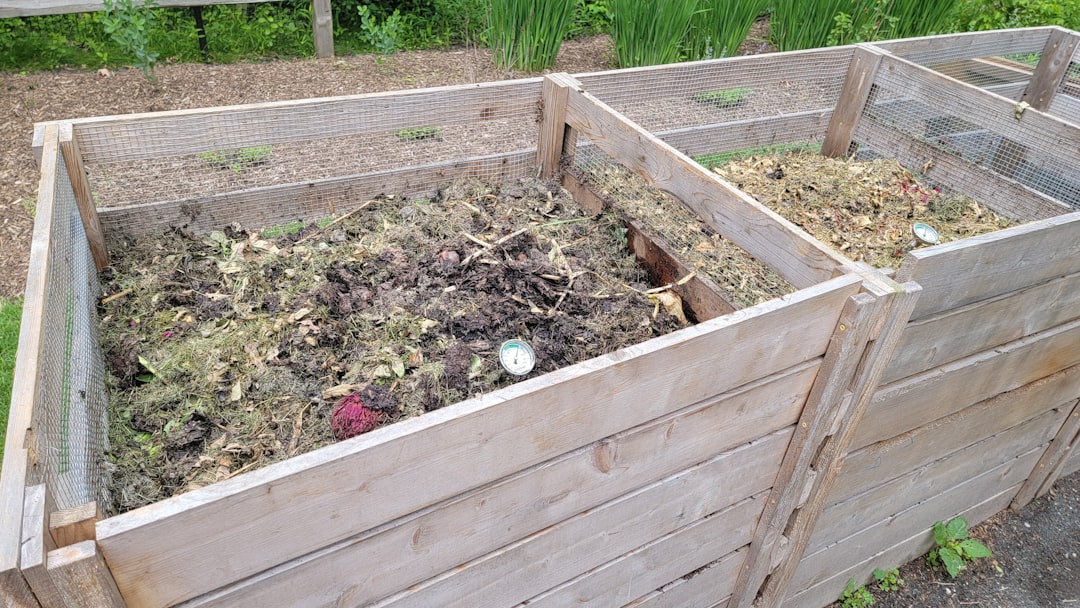
If you already know the basics of turning kitchen scraps into finished soil, the next question is simply what to put it all in. A good compost bin keeps your home and garden setup tidier, holds heat better than an open pile, and keeps curious pets or wildlife out of your scraps.
This is a buying guide, not a how-to — if you want the full rundown on browns vs greens, C:N ratios, and troubleshooting a smelly pile, our guide to starting composting covers all of that in depth. Here, we’re focused purely on which bin to actually buy.
We’ll cover the three main bin types — tumblers, stationary bins, and worm bins — how to size one for your household versus a larger operation, and four real products worth considering.
What to Look for in a Compost Bin
Before comparing specific products, it helps to know which bin style actually fits your yard, your patience level, and how much waste you’re generating.
Bin Types: Tumbler vs Stationary vs Worm Bin
A tumbler is an enclosed drum mounted on a frame that you spin to mix the contents instead of turning it by hand with a fork. Tumblers are faster to work with, keep pests out more reliably since the whole thing is sealed, and can produce finished compost in as little as a few weeks with regular spinning. The tradeoff is capacity — most tumblers hold less volume than a stationary bin of similar footprint. If you’d rather skip an outdoor bin entirely, our bokashi composting guide covers an indoor, odor-free alternative.
A stationary bin is a fixed, open-bottomed container that sits directly on the ground, letting worms and soil microbes migrate in naturally. These tend to hold more volume than tumblers and require no mechanical parts, but you’ll still need to turn the contents periodically with a fork or aerator tool to keep the pile from compacting.
A worm bin (vermicomposting) uses red wiggler worms to break down scraps indoors or in a garage, producing worm castings that are noticeably richer in nutrients than standard compost. Worm bins are compact, odor-free when managed correctly, and a good fit for apartments, small yards, or cold climates where an outdoor pile slows to a crawl in winter.
Sizing for Household vs Larger Operations
A single household generating mostly kitchen scraps is usually well served by a 30–40 gallon tumbler or a small worm bin, since that volume of food waste alone rarely fills anything larger before it breaks down. Once you start adding significant yard waste — grass clippings, fall leaves, garden trimmings — a stationary bin in the 80–100 gallon range gives you the headroom to keep up without the pile overflowing, which matters if that compost is ultimately headed for raised garden beds that need regular topping up.
If you’re running anything closer to a small homestead than a backyard garden, consider two bins rather than one oversized unit — one actively filling while the other finishes curing keeps a steady supply of usable compost rather than one big batch a few times a year. It’s also worth keeping a small countertop caddy in the kitchen itself, so scraps get collected as you cook rather than making a daily trip outside.
The 4 Best Compost Bins
These four picks cover the main bases: a fast-composting tumbler, a large-capacity stationary bin, an odor-free worm bin, and a small countertop caddy for collecting scraps in the kitchen.
1. FCMP Outdoor HOTFROG Dual-Chamber Tumbling Composter (37 Gallons)
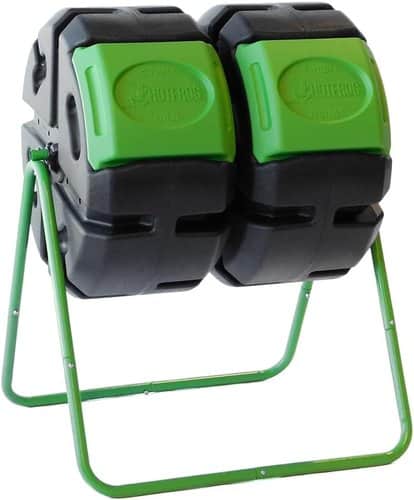
This tumbler’s split into two separate chambers, which is the detail that makes it genuinely useful rather than just a spinning barrel. You fill and cure one side while continuing to add fresh scraps to the other, so you’re never stuck waiting on a single batch to finish before you can add more.
The UV-inhibited, BPA-free plastic body sits on a powder-coated steel frame, and aeration vents on the drum keep oxygen flowing without you needing to add anything manually beyond the occasional spin.
At 37 gallons total capacity split across two chambers, it’s sized well for a household generating a steady stream of kitchen scraps and moderate yard waste.
Pros of the FCMP HOTFROG Tumbler
- Dual chambers let you cure one batch while filling another
- Sealed design keeps pests out
- Spinning mixes the pile without forking by hand
Cons of the FCMP HOTFROG Tumbler
- Lower total volume than a stationary bin of similar footprint
- Full drum can be heavy to spin
2. Algreen Soil Saver Classic Compost Bin (94 Gallons)
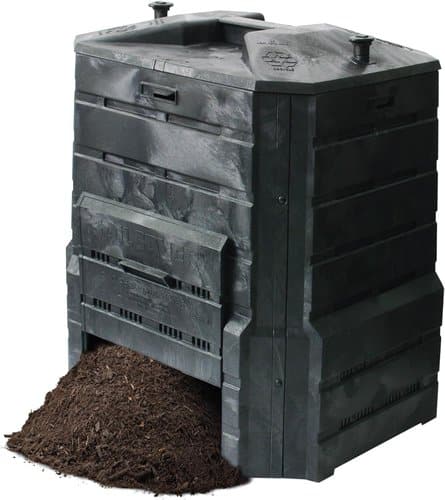
This stationary bin is built from 100% recycled plastic and holds roughly 94 gallons (about 12 cubic feet), which puts it well ahead of most tumblers on sheer capacity. It’s a good match if you’re composting real volumes of yard waste alongside kitchen scraps, not just the occasional coffee grounds and vegetable peels.
Because it’s open-bottomed and sits directly on soil, worms and beneficial microbes move in on their own, which speeds up breakdown compared to a fully sealed tumbler. A sliding door near the base makes it easy to harvest finished compost from the bottom of the pile without disturbing the fresher material on top.
It doesn’t spin or tumble, so you’ll still want to turn the contents with a fork every couple of weeks to keep airflow moving through the pile.
Pros of the Algreen Soil Saver Classic
- Large 94-gallon capacity for heavier yard waste loads
- Bottom door makes harvesting finished compost easy
- Made from 100% recycled plastic
Cons of the Algreen Soil Saver Classic
- No tumbling mechanism — still requires manual turning
- Large footprint takes up more yard space
3. Worm Factory 360 4-Tray Worm Composter
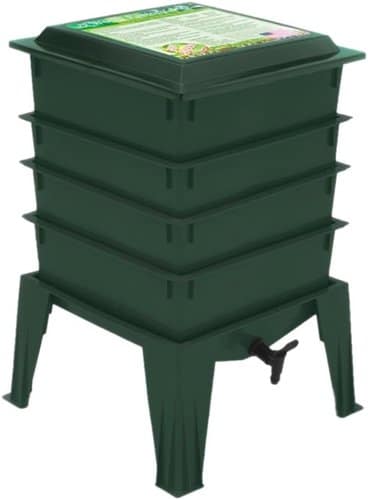
The Worm Factory 360 is the standard recommendation for anyone getting into vermicomposting, and it works equally well in a garage, basement, apartment balcony, or outdoors in mild climates. Red wiggler worms move up through the stacked trays as lower ones finish, so harvesting means lifting off a completed tray rather than digging through an active pile.
Worm castings produced this way are noticeably more concentrated in nutrients than standard yard compost, and a built-in spigot lets you drain off “worm tea” liquid fertilizer as a bonus.
It starts at four trays and can expand up to eight, so it scales with you if composting becomes a bigger part of your routine. Keep it somewhere between 40–80°F for the worms to stay active and comfortable.
Pros of the Worm Factory 360
- Works indoors, in a garage, or on a balcony
- No turning required — worms do the mixing
- Expandable from 4 up to 8 trays as needed
Cons of the Worm Factory 360
- Requires live worms purchased separately
- Handles far less yard waste volume than an outdoor bin
4. Barnyard Designs Kitchen Counter Compost Bin (1.2 Gallons)
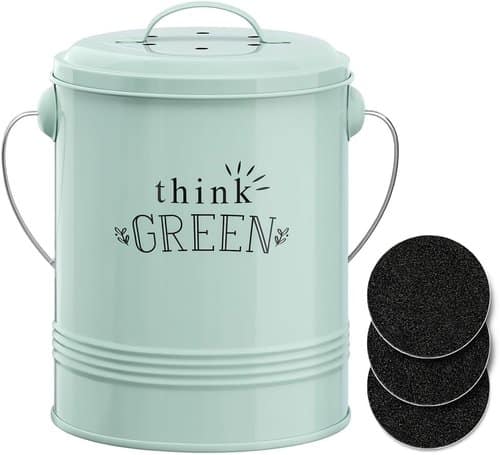
This isn’t a full composting system — it’s the small caddy that sits on your counter and collects scraps until you’re ready to walk them out to whichever bin above you’ve chosen. It’s a small detail, but having one genuinely changes how consistently you compost, since scraps get collected as you cook instead of tossed in the trash out of convenience.
The removable inner bucket and smell-absorbing filter keep it from turning into a fruit-fly magnet between trips outside, and at 1.2 gallons it’s sized to hold a day or two of scraps without needing constant emptying.
It’s a cheap, low-commitment add-on to any of the other three bins on this list, and honestly one of the more overlooked pieces of a working compost setup.
Pros of the Barnyard Designs Countertop Bin
- Makes daily scrap collection far more consistent
- Smell-absorbing filter keeps odors and flies down
- Inexpensive add-on to any outdoor bin
Cons of the Barnyard Designs Countertop Bin
- Small capacity needs emptying every day or two
- Filters need replacing periodically to stay effective
Conclusion
The right compost bin depends mostly on how much waste you’re generating and how hands-on you want to be. A tumbler suits a household that wants quick results with minimal effort, a stationary bin makes sense once yard waste volume climbs, and a worm bin is the best fit for small spaces or year-round indoor composting.
Whichever you pick, pairing it with a small kitchen caddy will do more for how consistently you actually compost than almost any other upgrade.
FAQ — Compost Bins
A tumbler is a sealed, rotating drum that you spin to mix the pile, while a stationary bin sits open-bottomed on the ground and needs manual turning with a fork. Tumblers are faster and keep pests out better; stationary bins usually hold more volume.
A 30-40 gallon tumbler or a 4-tray worm bin is usually enough for a household composting mostly kitchen scraps. If you’re adding significant yard waste, an 80-100 gallon stationary bin gives more headroom.
Neither is strictly better — a worm bin produces more nutrient-dense castings and works well indoors or in small spaces, while a stationary or tumbler bin handles far more volume, including yard waste that worm bins aren’t suited for.
Related: New to composting itself? Start with our beginner’s guide to composting for the browns-to-greens ratio, turning schedule, and troubleshooting tips, or see our guide to making your own fertilizer for what to do with the finished product.