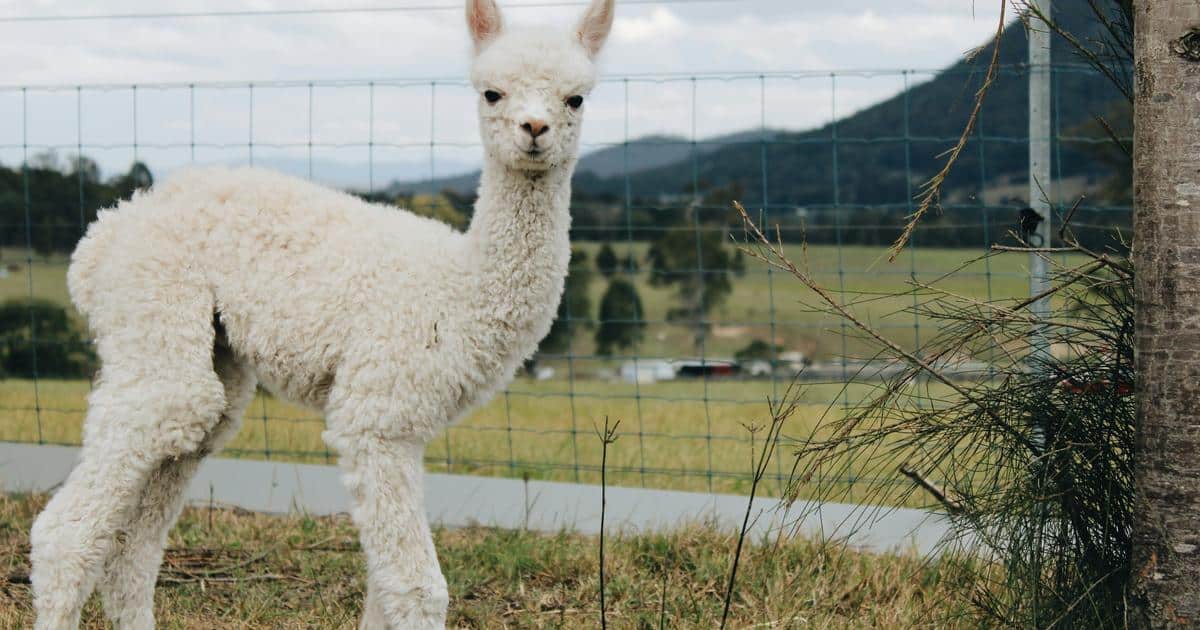
Alpacas live on grass hay and pasture, eating roughly 1.5 to 2% of their body weight in dry matter each day, which is about 2 to 4 lb of hay for a typical adult. They are remarkably economical to feed for a livestock animal, and most need no grain whatsoever.
Like llamas, alpacas are camelids with a three-compartment stomach, evolved on thin high-altitude forage. The single most common feeding error is treating them as though they need rich feed, they do not, and obesity is a real problem in pet alpacas.
What Alpacas Eat Day to Day
- Pasture. The mainstay in the growing season. Alpacas are primarily grazers, taking grass rather than browsing shrubs the way goats do.
- Grass hay. The winter staple, and the year-round base where grazing is limited. Timothy, orchard or mixed meadow.
- Alfalfa. Reserve it for pregnant or lactating females and growing crias. Too rich for routine adult feeding.
- Camelid pellets. A small measured supplement where forage alone is not enough.
- Camelid minerals. Free-choice, formulated for alpacas and llamas.
- Clean water. Constant access, and check troughs in winter for ice.
Alpacas graze more selectively and closer than llamas, and they nibble rather than tear, which is easier on pasture. They also tend to use communal dung piles, which makes paddock cleaning simple and helps with parasite control if you clear them regularly.
Quick Facts: Feeding Alpacas
- Roughly 1.5–2% of body weight in dry matter daily, about 2–4 lb of hay
- Grass hay, not alfalfa, for most adults
- Most alpacas need no grain at all
- Never keep just one, alpacas are herd animals and need company
- Check body condition by hand, fleece hides everything
Why Grass Hay Rather Than Alfalfa
Alfalfa is a legume, higher in protein and calcium and considerably more energy-dense than grass hay. For an idle adult alpaca that surplus goes on as fat, and an overweight alpaca is harder to spot than an overweight horse because the fleece hides it entirely.
Assess condition by putting hands on the animal, feeling along the spine and over the ribs, rather than judging by appearance. Do it at shearing too, when you can actually see the body underneath, it is often a surprise in both directions.
Minerals, Selenium and Vitamin D
A camelid-specific free-choice mineral is the right default. Avoid goat minerals, which carry more copper than camelids need.
Two region-specific issues are worth raising with a local vet. Selenium is deficient in the soils of large parts of the US, and camelids in those areas commonly need supplementation. Vitamin D deficiency also affects young crias born into low-light winters at northern latitudes, causing rickets, and injectable supplementation is routine practice in some regions. Neither is something to guess at from a general guide.
Alpacas and Llamas Compared
Dietary needs are near-identical and the same principles apply to both. Practically, an alpaca is roughly half the weight of a llama, grazes more selectively, and is kept primarily for fleece rather than as a pack or guard animal. Our guide to what llamas eat covers that side, including the guarding role.
One thing shared by both and worth stating plainly: never keep a single animal. Camelids are herd animals and a solitary alpaca is a genuinely stressed one. Three is a better minimum than two.
Foods and Plants to Avoid
| Avoid | Why |
|---|---|
| Alfalfa as routine adult feed | Too rich, leads to obesity hidden under fleece |
| Grain fed as a habit | Unnecessary calories for an animal built on sparse forage |
| Goat minerals | More copper than camelids need |
| Mouldy hay | Mycotoxins |
| Rhododendron, azalea, oleander, yew | Toxic |
| Wilted cherry leaves | Cyanide compounds |
| Lawn clippings | Rapid fermentation, digestive upset |
For how this compares across the rest of the yard, see our overview of what most farm animals eat, or browse the full farm feed hub.
Other feeding guides in this group (other livestock): pigs eat, horses eat, rabbits eat. Or start from the overview of what most farm animals eat.
Grass hay and pasture, at roughly 1.5 to 2% of body weight in dry matter daily, which is about 2 to 4 lb of hay for an adult. Most alpacas need no grain, and alfalfa should be reserved for pregnant or nursing females and growing crias.
Around 2 to 4 lb a day for a typical adult, based on 1.5 to 2% of body weight. Alpacas are unusually economical to feed for their size.
Most do not. A small measured camelid pellet helps where forage alone is not enough, or for pregnant and lactating females, but routine grain is how pet alpacas become overweight.
Only in limited situations. Alfalfa is too rich for idle adults and leads to obesity that fleece conceals. It suits pregnant or lactating females and growing crias.
Essentially yes, the nutritional requirements are near-identical. The practical differences are size and purpose rather than diet, an alpaca is about half a llama’s weight and is kept mainly for fleece.
No. Alpacas are herd animals and a single alpaca becomes genuinely stressed. Keep at least two, and three or more is better.